
Search is no longer just about Google.
Today, users are increasingly turning to AI systems like ChatGPT, Perplexity, Gemini, and Claude to find answers.
This shift is redefining how content is discovered — and optimized.
Welcome to the era of AI SEO.
What is Traditional SEO?
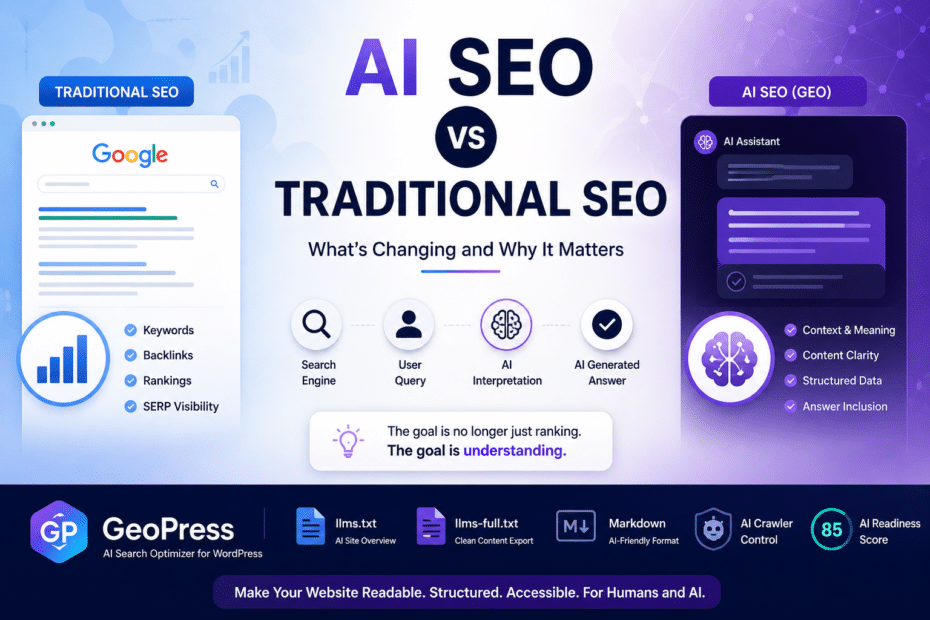
Traditional SEO focuses on optimizing content for search engines like Google.
It is based on:
- Keywords
- Backlinks
- Technical optimization
- Indexing and rankings
The goal is simple:
Rank higher in search results.
What is AI SEO?
AI SEO (also called Generative Engine Optimization – GEO) focuses on making content understandable for AI systems.
Instead of ranking pages, AI systems:
- Read content
- Interpret meaning
- Generate answers
This changes everything.
You are no longer optimizing for rankings.
You are optimizing for understanding.
Key Differences: AI SEO vs Traditional SEO
| Traditional SEO | AI SEO (GEO) |
|---|---|
| Focus on ranking | Focus on understanding |
| Keywords-driven | Context-driven |
| SERP visibility | Answer inclusion |
| Crawling & indexing | Content interpretation |
| Backlinks important | Structure & clarity important |
How AI Systems Read Content
AI systems don’t “rank” pages like Google.
They:
- Extract structured information
- Identify key concepts
- Rebuild answers using multiple sources
This means:
- messy content = ignored
- clear structure = usable
Why Most WordPress Sites Are Not AI-Ready
Out of the box, WordPress is not optimized for AI systems.
Common issues:
- HTML-heavy content
- Lack of semantic structure
- No clean data export
- Poor content hierarchy
👉 AI struggles to extract clean information.
What Makes Content AI-Friendly?
To be readable by AI, content should have:
- Clear headings (H1, H2, H3)
- Logical structure
- Clean text (no unnecessary markup)
- Context-rich paragraphs
- Explicit meaning (not vague writing)
And ideally:
- Machine-readable versions of content
The Role of llms.txt in AI SEO
One of the emerging standards is llms.txt.
It helps AI systems:
- understand your site structure
- find important pages
- navigate content efficiently
If you haven’t read it yet:
👉 Read: What is llms.txt? (link al primo articolo)
The Missing Layer: AI-Readable Content
Here’s the real problem:
Even if your content is good, AI systems often struggle to extract it.
That’s because:
- HTML is noisy
- structure is inconsistent
- data is not optimized for machines
👉 This is where a new layer is needed.
Introducing MICROPEDIA AI Search Optimizer
Micropedia– AI Search Optimizer transforms WordPress into an AI-readable source.
It adds:
- llms.txt (AI site overview)
- llms-full.txt (clean content export)
- Markdown versions of posts
- AI crawler control
- AI Readiness Score
All without modifying your original content.
Why This Matters Now
AI search is growing fast.
And early adopters have an advantage.
Websites that are:
- structured
- clear
- machine-readable
will be easier for AI systems to use in answers.
Is AI SEO Replacing Traditional SEO?
No.
But it is expanding it.
The future is:
SEO + GEO
You still need:
- rankings
- traffic
- visibility
But you also need:
- interpretability
- clarity
- structured data
Final Thoughts
The way content is consumed is changing.
From search results → to generated answers.
If you want to stay ahead:
- optimize for humans
- optimize for search engines
- optimize for AI
Next Steps
- Read: What is llms.txt
- Implement AI-friendly structure
- Use tools like Micropedia AI search optimizer